


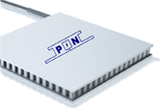
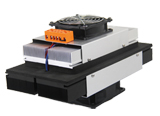



Principle of Thermoelectric (Semiconductor) Cooling
Thermoelectric cooling technology is based on the Peltier effect. When a direct current passes through a thermocouple composed of two different semiconductor materials, a temperature difference is generated between the two ends of the couple, enabling directional heat transfer.
Its core structure consists of alternately arranged N-type and P-type semiconductor elements, electrically connected by metal interconnects to form a thermoelectric module (thermopile). By coupling a heat dissipation side and a cooling side, precise temperature control can be achieved.
Advantages of Thermoelectric Cooling in Microfluidic Systems
1. Miniaturization and High Integrability
In microfluidic systems, miniature or small-sized thermoelectric modules—typically 10 × 10 mm or even smaller—can be employed. With power densities of 30–100 W/cm², these modules can be directly integrated into the temperature control unit of microfluidic chips, meeting the stringent space constraints of Lab-on-a-Chip applications.
2. High-Precision Temperature Control
Temperature control accuracy can reach ±0.1°C, with fast response times and a wide operating temperature range from –40°C to 150°C. This makes thermoelectric cooling highly suitable for temperature-sensitive microfluidic processes such as PCR amplification and enzymatic reactions.
3. Contactless Cooling
Temperature regulation is achieved through solid-state heat conduction rather than fluid-based cooling media, eliminating vibration interference and the risk of fluid contamination associated with traditional compressor-based refrigeration systems. This significantly enhances the reliability of biological sample analysis.
4. Low Power Consumption and Environmental Sustainability
Thermoelectric systems deliver precisely matched power output and can achieve over 30% energy savings compared with conventional cooling methods. With no refrigerants such as Freon or other greenhouse gas emissions, they align well with the trends toward portability and environmental sustainability in miniature medical devices.
5. Bidirectional Temperature Control
By reversing the direction of the driving current, a single thermoelectric module can switch seamlessly between cooling and heating, simplifying temperature cycling designs in microfluidic systems (e.g., DNA denaturation–annealing–extension processes).
Recommend Thermoelectric Product Series
1. Design Requirements
① Temperature-controlled object: cell suspension between double-layer glass substrates
② Target temperature range: 8–130°C
③ Temperature control accuracy: ±0.1°C
④ Dimensional constraints of the temperature control device: 70 × 55 × 35 mm
⑤ Other specifications: maximum heating/cooling rate ≥ 4°C/s, temperature overshoot ≤ 0.5°C, 24 V power supply
2. Product Design
To fully meet the customer’s stringent requirements for temperature control performance and compact device dimensions, multiple rounds of comparison and validation were conducted on candidate thermoelectric modules. Ultimately, three miniature 18 × 18 mm thermoelectric coolers were selected.
These modules deliver uniform and efficient cooling performance within a limited space, achieving an optimal balance between system compactness and heat dissipation capability.
High-temperature solder was employed during assembly to enhance the connection reliability and long-term stability of the thermoelectric modules under sustained high-temperature operating conditions, thereby extending the service life of the core components from a manufacturing and process perspective.
In terms of temperature control system design, to achieve a comprehensive performance target of high precision, high accuracy, and fast dynamic response, the key heat-conducting component—the aluminum plate—was structurally optimized and analyzed through thermal simulation.
By rationally optimizing flow channel layout and thickness distribution, heat transfer efficiency was significantly improved, resulting in enhanced temperature control speed and uniformity.
In addition, the system integrates three high-precision PT1000 temperature sensors, which continuously monitor temperature variations at both the cold side and the hot side. This multi-point temperature monitoring strategy provides comprehensive feedback on the thermal field, enabling the control system to perform rapid and accurate adjustments and ensuring that the temperature-controlled object remains consistently within the desired operating range.
Contact our sales team for more details info about Microfluidics thermal solution: info@pengnantech.com