In recent years, the low-altitude economy has been incorporated into national strategic development plans, and the drone industry is experiencing rapid growth. According to data from the Civil Aviation Administration of China, the number of registered drones in China reached 3.287 million by the end of 2025, and the overall market size of the low-altitude economy is expected to exceed one trillion RMB by 2026.
As drones fly higher, farther, and for longer durations, the stability requirements for onboard electronic systems become increasingly stringent. With high integration of subsystems such as infrared imaging, high-performance lithium batteries, flight control, and communication modules, heat accumulation has become a critical risk affecting flight safety.
When traditional air-cooling systems struggle to cope with the thermal load, and liquid cooling systems are often too heavy and complex, a quiet and highly efficient solid-state cooling technology—thermoelectric cooling (TEC)—is emerging as a promising solution for thermal management in drones.
You may have seen a fascinating phenomenon: when a small thermoelectric module is powered by DC current, one side quickly becomes cold and even forms frost, while the other side becomes hot.
This is based on the "Peltier Effect," discovered in 1834 by French physicist Jean Charles Athanase Peltier. When a direct current passes through a circuit composed of N-type and P-type semiconductor materials, electrons transfer heat from one side to the other, resulting in simultaneous heat absorption and heat release.
Multiple thermoelectric couples connected in series form a thermoelectric module (TEC), enabling precise temperature control over a wide range of approximately –130°C to 150°C. Heating and cooling can be achieved simply by reversing the direction of the current.
Compared with traditional compressor-based systems and complex liquid cooling solutions, TEC technology offers several key advantages for drone applications:
Solid-state, vibration-resistant: No moving parts, ensuring silent and highly reliable operation under vibration and shock.
Precise temperature control: Fast response time, enabling sub-0.01°C-level temperature regulation in certain applications.
Compact and easy integration: Simple structure, ideal for space- and weight-constrained drone platforms.
Environmentally friendly: No refrigerants required; a single module enables both heating and cooling by current reversal.
The application of TEC in drones is not limited to a single subsystem but spans across the entire onboard thermal ecosystem and ground support systems.
LiDAR is a core sensor in industrial drones used for surveying, inspection, and security applications. In laser radar systems, the emission wavelength of semiconductor laser diodes is strongly dependent on junction temperature: for every 1°C increase, the wavelength typically shifts by approximately 0.2–0.3 nm.
This wavelength drift can cause the return signal to fall outside the narrow-band optical filter, resulting in complete measurement failure. Therefore, wavelength stability is a functional requirement rather than a performance optimization.
Operating temperature ranges for LiDAR systems vary depending on design and application, typically between –40°C and 85°C.
Thermoelectric cooling (TEC) is a mainstream hardware solution for maintaining laser diode wavelength stability in LiDAR systems. Engineering challenges include sub-millikelvin temperature control, thermal management of optical components, and even multi-stage cooling for wavelength tuning applications.
Batteries are a major limiting factor in drone endurance. In high-temperature environments, lithium-ion batteries may suffer from overheating, swelling, or thermal runaway. In low temperatures below –10°C, usable capacity can decrease by up to 30%.
TEC systems can be integrated into the Battery Management System (BMS) to provide active thermal regulation: cooling when temperatures are too high and heating when temperatures are too low. This keeps the battery within the optimal operating range of 25–40°C, improving both lifespan and charge/discharge efficiency.
By simply reversing current direction, TEC modules enable seamless bidirectional thermal control, perfectly matching the dual heating and cooling requirements of drone battery systems.
In high-altitude or extreme environments, stable operation of motor controllers and servo systems is critical.
Thermoelectric cooling modules can dissipate heat from power electronics during normal operation and switch to heating mode in low-temperature environments at high altitude, ensuring that electronic components remain within optimal operating conditions. This significantly enhances system reliability while reducing strict environmental design constraints.
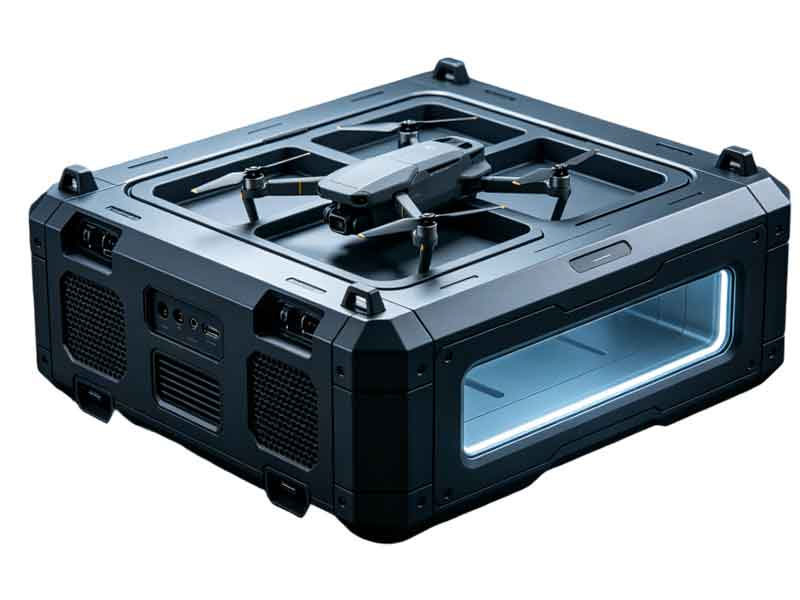
Drone stations serve as "base hubs" for charging and parking in outdoor environments. Their internal temperature control systems directly determine whether fully autonomous operations can be achieved.
In summer, internal temperatures can exceed 60°C, reducing charging efficiency and increasing safety risks. In winter, low temperatures significantly reduce battery capacity.
A TEC-based system can provide both cooling and heating simply by reversing current direction. Combined with high-precision temperature sensors and PID control algorithms, temperature stability within ±0.1°C can be achieved.
Because TEC modules have no moving parts and require no refrigerants, they are highly reliable for drone stations deployed in remote or hard-to-maintain environments such as mountains or rooftops.
Despite its advantages, integrating TEC into drone systems remains a system-level engineering challenge:
Energy efficiency coordination: TEC is essentially a heat pump. Without sufficient heat dissipation on the hot side, system performance degrades rapidly. In high-power applications, forced air cooling with heat sinks or even liquid cooling systems is often required.
Precise thermal control: High-accuracy NTC sensors combined with PID algorithms are needed for dynamic power regulation and energy optimization.
Environmental protection and airflow design: Drone enclosures require IP65 or higher protection, and internal airflow must be carefully designed to ensure uniform heat distribution.
Life-cycle cost considerations: Although initial costs may be higher than traditional solutions, TEC systems offer long-term advantages such as no moving parts, no refrigerant maintenance, and lower operational costs.
At P&N, we prefer to view TEC not simply as a cooling component, but as a precision thermal control tool.
For drones, what truly matters is not temperature itself, but the long-term stability of critical components under operating conditions.
Different applications have different requirements in terms of thermal accuracy, power consumption, weight, and reliability. Therefore, each solution must be system-designed rather than simply optimized for lower temperature.
With the rapid development of LiDAR, infrared sensing, drone stations, and long-endurance platforms, we believe that precision thermal management will play an increasingly important role in future drone systems.
P&N will continue to work closely with customers to explore more efficient and reliable thermoelectric thermal management solutions.


 EN
EN