The Role of Thermoelectric Coolers (TEC) in CCD, CMOS, InGaAs and VOx Detectors
As imaging technologies continue to evolve toward higher sensitivity, higher resolution, and broader spectral coverage, thermal management has become a key factor affecting detector performance.
Whether used in scientific research, industrial inspection, infrared imaging, or aerospace applications, detector temperature directly influences image quality, signal stability, measurement accuracy, and long-term reliability.
Although different detector technologies operate across different wavelength ranges, they share one common challenge:
Their performance is highly dependent on temperature.
This is why Thermoelectric Coolers (TECs) have become an essential thermal management solution for many high-performance Focal Plane Array (FPA) systems.
Unlike compressor-based cooling technologies, TECs provide solid-state, vibration-free, maintenance-free temperature control while offering excellent temperature stability in a compact package.
What Is an FPA?
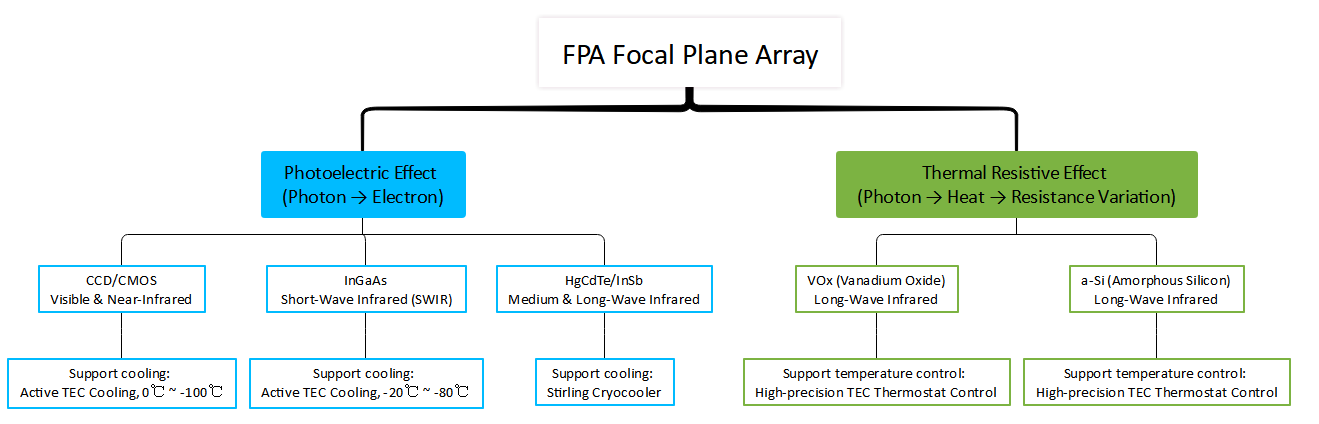
A Focal Plane Array (FPA) is a two-dimensional array of detector elements positioned at the focal plane of an optical system. It converts incoming optical signals into electrical signals that are processed to generate digital images.
Depending on detector material and operating wavelength, FPAs are commonly classified into four categories:
Although each detector technology has unique characteristics, precise temperature control is essential for achieving stable imaging performance.
Four Detector Technologies, Four Different Thermal Challenges
Scientific CCD
Scientific CCD detectors are widely used in astronomy, fluorescence microscopy, spectroscopy, and other ultra-low-light applications.
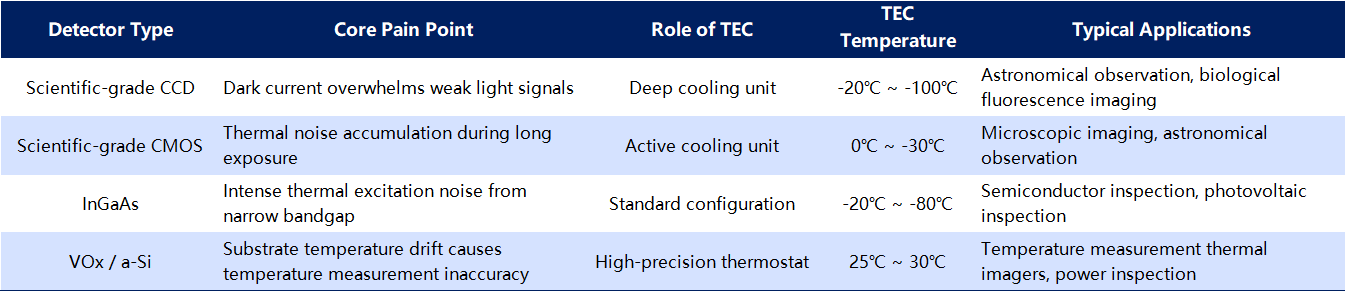
Their biggest challenge is dark current, which increases exponentially with temperature. As a general engineering rule, dark current is reduced by approximately 50% for every 6–7°C decrease in detector temperature.
Multi-stage TECs combined with precision PID temperature control can maintain detector temperatures as low as –20°C to –100°C, significantly improving signal-to-noise ratio and enabling long-exposure imaging.
P&N & i-TEC Engineering Recommendation
Multi-stage TECs with closed-loop PID temperature control are recommended for long-exposure CCD systems requiring maximum image stability.
Scientific CMOS
Scientific CMOS (sCMOS) sensors provide high speed, low readout noise, and excellent dynamic range.
Although CMOS technology offers lower power consumption than CCD, thermal noise still becomes a limiting factor during long-exposure imaging.
Active TEC cooling typically maintains detector temperatures between 0°C and –30°C, reducing thermal noise and improving image consistency.
Consumer cameras generally rely on passive cooling, while scientific CMOS systems frequently require active temperature control.
P&N & i-TEC Engineering Recommendation
Active TEC cooling is recommended for scientific CMOS systems operating under long-exposure or low-light conditions.
InGaAs SWIR Detectors
InGaAs detectors are widely used in short-wave infrared (SWIR) imaging for semiconductor inspection, photovoltaic testing, machine vision, remote sensing, and defense applications.
Because InGaAs has a relatively narrow bandgap, thermally generated carriers increase rapidly as temperature rises, producing significant thermal noise.
For this reason, TEC cooling has become standard practice rather than an optional feature in high-performance SWIR systems.
Typical operating temperatures range from –20°C to –80°C, depending on detector design and application requirements.
P&N & i-TEC Engineering Recommendation
For industrial SWIR imaging systems, TEC cooling should be considered an integral part of detector design rather than simply a performance enhancement.
VOx / a-Si Uncooled Infrared Detectors
Although VOx and a-Si microbolometers are commonly referred to as uncooled infrared detectors, they still require highly stable operating temperatures.
Temperature fluctuations caused by ambient conditions or detector self-heating can introduce thermal drift, reducing image consistency and measurement accuracy.
Rather than providing deep cooling, TECs maintain the detector substrate at a stable temperature—typically around 25°C to 30°C—to minimize drift and ensure reliable thermal imaging performance.
P&N & i-TEC Engineering Recommendation
In precision thermal imaging applications, maintaining a stable detector temperature is often more important than achieving the lowest possible temperature.
Engineering Perspective
Although CCD, CMOS, InGaAs, and VOx detectors all benefit from temperature control, their thermal management objectives are fundamentally different.
For this reason, selecting a TEC is not simply about cooling capacity. A successful thermal management solution also requires careful consideration of heat dissipation, control algorithms, package design, power consumption, and long-term reliability.
For high-performance imaging systems, a TEC is not simply a cooling device—it is an integral part of the overall thermal management system.
Conclusion
As scientific imaging, SWIR technology, infrared sensing, and aerospace applications continue to advance, the demand for precise thermal management will continue to grow.
Different detector technologies require different temperature control strategies, but they all share the same objective: maintaining stable detector performance under changing environmental conditions.
At P&N & i-TEC, we remain committed to developing reliable thermoelectric cooling solutions for advanced imaging systems. By combining engineering expertise with customized TEC technologies—from miniature single-stage modules to multi-stage cooling solutions—we continue to help customers improve imaging performance, system stability, and long-term reliability across a wide range of applications.


 EN
EN